
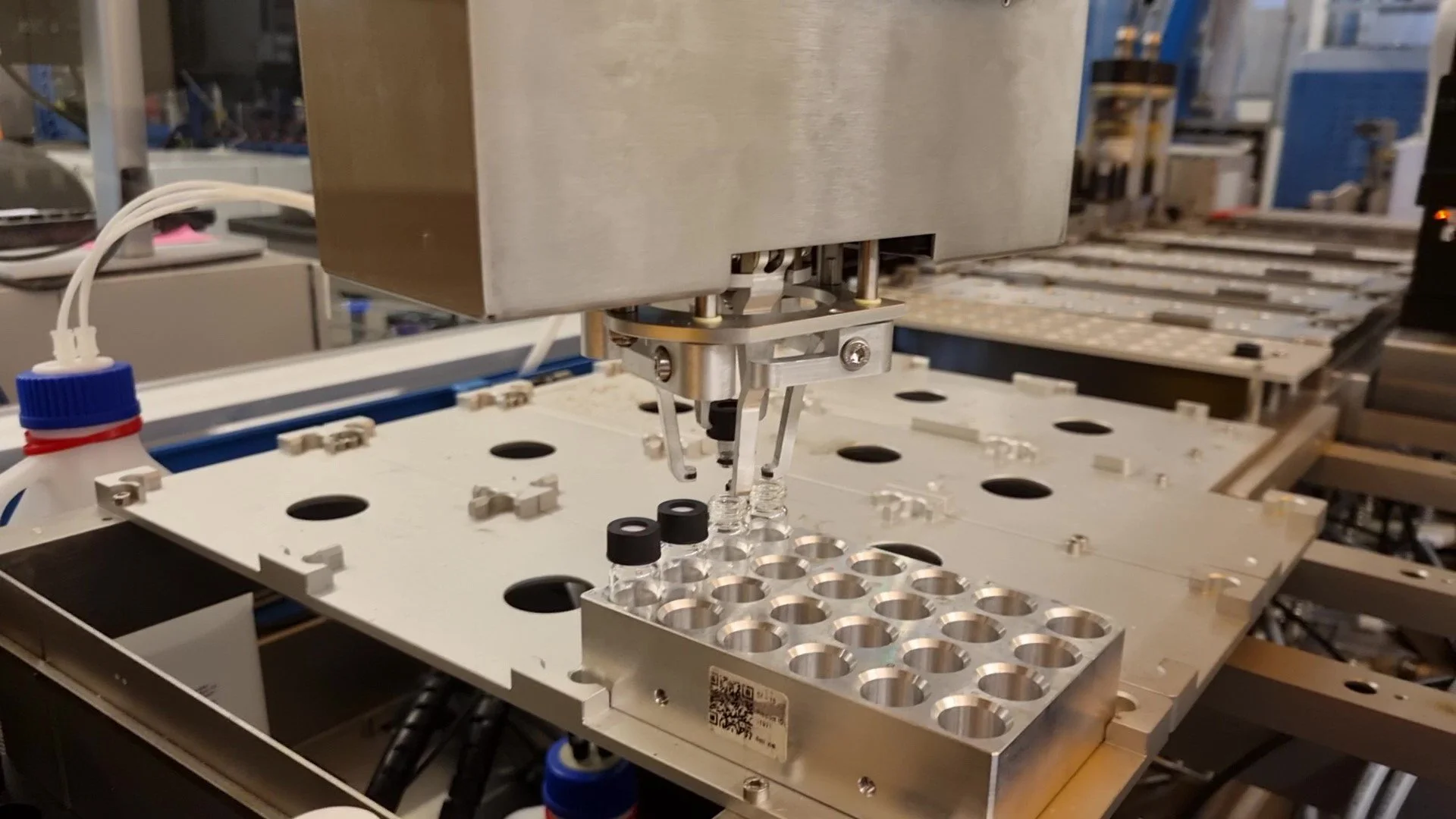
A self-driving laboratory for autonomous materials discovery and process optimization
To move beyond manual trial-and-error experimentation and to create an intelligent laboratory that accelerates discovery in energy, advanced materials, health and environment for the economics of the future.
We integrate robotics, computational chemistry, and machine learning into a closed-loop experimental platform that can synthesize, analyze, learn, and optimize with minimal human intervention.
Our Mission
Reimagining how molecules, materials, and processes are discovered
Traditional synthesis and materials development rely heavily on repetitive manual experimentation, low-throughput decision making, and researcher-dependent reproducibility. Our approach replaces that model with an integrated, data-rich workflow in which robotics execute experiments and AI continuously interprets and optimizes outcomes.
By connecting experimentation, descriptor generation, data infrastructure, and predictive optimization, the laboratory becomes a learning system. This creates a practical route toward faster discovery cycles, better reproducibility, lower cost, and access to opportunities that would likely remain hidden using conventional methods.
Platform Architecture
A closed-loop workflow from experiment to prediction to the next experiment
The self-driving lab mirrors a complete synthesis environment with automated storage, dispensing, reaction execution, workup, and analysis. Experimental outputs are combined with computational descriptors and passed directly to learning algorithms that decide what should be tested next.
AI Integration into a Robotic Platform
We are building a fully automated synthesis environment that mirrors a modern laboratory: storage, reaction, workup, and analysis are connected through coordinated robotics. Experimental data flows directly into optimization models, enabling closed-loop decision making without manual intervention.
Descriptor Generation at Scale
Automated computational pipelines generate electronic, geometric, and steric descriptors across large chemical and materials spaces. These descriptor libraries provide the foundation for interpretable machine learning and accelerated exploration of reaction and material performance.
AI for Autonomous Optimization
We develop machine learning frameworks that can propose the next best experiment, learn continuously from new results, and generalize to unseen chemical systems. The goal is a self-driving discovery engine that identifies high-value conditions with minimal experimental burden.
Machine Learning for Chemical Reactions
Our platform combines molecular representations such as graphs, SELFIES, SMILES, and 3D structures with graph neural networks, reinforcement learning, and evolutionary algorithms to optimize synthetic performance, selectivity, and robustness.
IMPACT
Faster discovery, stronger reproducibility, and clearer industrial relevance
We anticipate substantial reductions in time and cost through parallelization, standardized operations, and algorithm-guided experimentation. The platform supports a transition from isolated experiments to scalable, reproducible, and application-ready discovery workflows.
Academic Value
Accelerates research cycles, increases experimental depth, and opens new possibilities in synthesis, catalysis, and materials chemistry.
Sustainability Value
Supports cleaner energy technologies, carbon capture solutions, and more efficient routes to valuable chemicals and functional materials.
Industrial Value
Enables faster process development, reduced labor intensity, improved data quality, and closer alignment with translational and deployment targets.
Scalability
The architecture can be adapted to future programs in membranes, solar materials, pharmaceuticals, plant protection, and water treatment.
Applications
Blueprint projects in energy and industrial innovation.
The platform is designed to be general, but the first high-impact application domains focus on CO₂ conversion, new membranes and pharmaceuticals synthesis. These case studies demonstrate how autonomous experimentation can accelerate catalyst and materials development for urgent sustainability challenges.
NEW Membranes
Autonomous discovery of advanced membrane materials for separations, focusing on selectivity, permeability, stability, and recyclability. The workflow spans polymer or framework synthesis, membrane fabrication, on-line characterization, separation testing and iterative AI-driven refinement.
Membrane fabrication and modification
Transport and separation analysis
AI-enhanced material evolution
CO₂ Hydrogenation
High-throughput catalyst synthesis and testing for CO₂ conversioninto methanol, methane, higher olefins, and other value-added products. The platform screens catalyst composition, supports, promoters, and temperatures to maximize conversion and selectivity while minimizing cost.
Automated catalyst preparation
Parallel reactor testing
Online analytics and AI-guided optimization
NEW Materials
Autonomous discovery of Metal Organic Frameworks (MOFs) and Covalent Oraganic Frameworks (COFs) focusing on selectivity, regeneration, stability, and recyclability. The workflow spans ligand synthesis, framework assembly, characterization, and iterative AI-driven refinement.
MOF/COF assembly and modification
Adsorption and structure analysis
AI-enhanced material evolution
Future Expansion
The same platform architecture will also enable photocatalysis, high-pressure and temperature synthesis, enzymatic transformations, pharmaceutical discovery, solar materials generation, water treatment, membrane development, and industrial process screening and optimization.
Photochemistry and pressure chemistry
High-throughput bioassays
Materials and process innovation
Vision
From automated experimentation to autonomous scientific discovery
The Lab of the Future is conceived as an intelligent research environment in which robotics, descriptors, and AI converge to discover catalysts, materials, and processes with unprecedented speed and rigor.